

why you believe you are not enough
we wake up, check our phone, maybe reply to some messages or just quickly scroll through social media. maybe we drink our first coffee to feel less tired, get dressed in clothes that fit the expectation of our immediate surrounding, hurry to catch the train or get in our car to avoid the traffic jam, work all day where we are guided by deadlines, milestones and very urgent topics only to then leave work, do some sport or meet some friends, prepare a home cooked dinner and include some time on our own to be mindful for 10 minutes.
we pack everything we can in our days because somehow we started to believe that we should have a career, move more, have more friends, be healthier, smarter, more beautiful and funny, a little less emotional and overall just not how we are. we are asked to optimize every single aspect of our life, all at the same time while hardly ever celebrating what we achieved.
it is never just enough, it can’t be. because if it was, our whole system wouldn’t work the way it does. let me explain.
ideal self vs. actual self
think about how you would like to be. how you would like to be perceived by others, how you would like to feel, look, act. this is your ideal self.
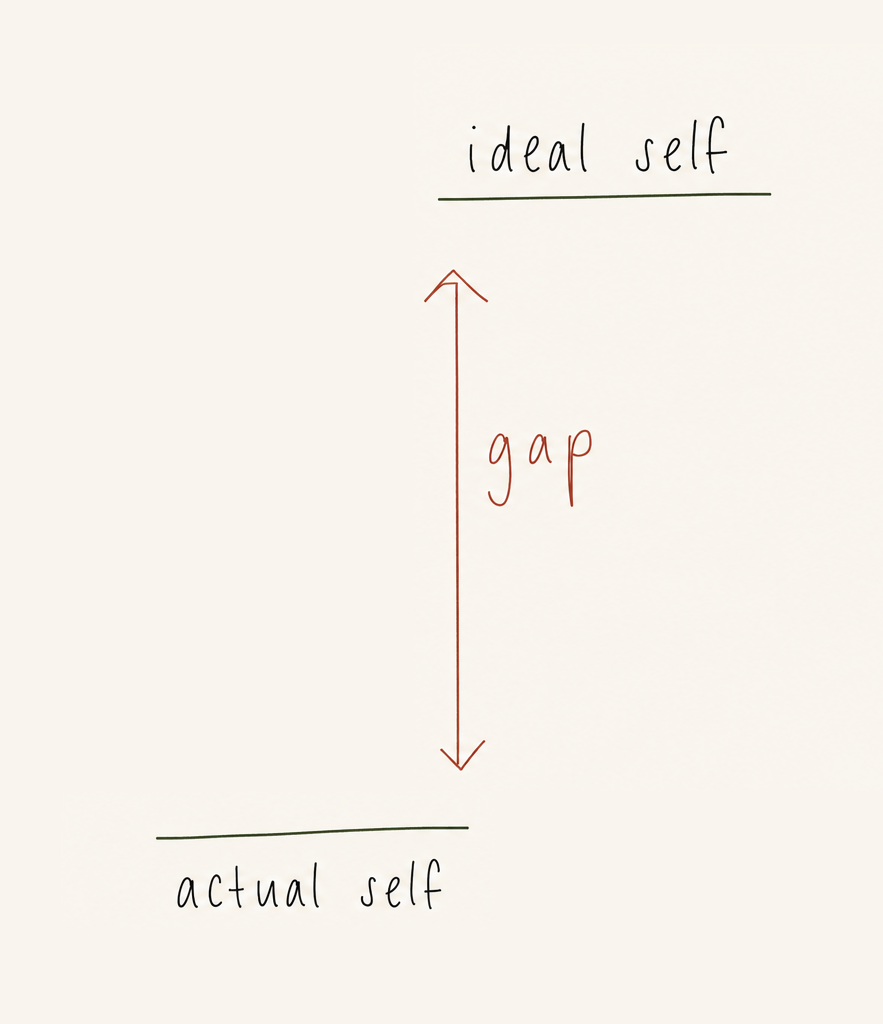
this concept is closely associated with Carl rogers and humanistic pyschology and defined as:
The ideal self is an individual's conception of the person they aspire to be, including desired abilities, characteristics, achievements, and ways of relating to others.
we then compare our actual or our real self, who we are right now, with our ideal self. according to rogers, a large gap between these two can create dissatisfaction, anxiety or low self-esteem.
additionally, in marketing and consumer behavior
The ideal self is a consumer's desired future self-image, which motivates preferences for products, brands, and experiences that symbolically move them closer to that image.
consumers often buy products not only for their functional benefits but also for what those products communicate about who they want to be. just as in the psychological perspective, there is also a differing actual or real self here. consumption is used to close the gap between the two.
so how does this relate to our topic?
consumerism
of all the things we own, we need almost none of them. we don't need the latest smartphone, we don't need 10 pairs of shoes and dozens of yoga outfits. we also don't need the most expensive coffee machine or the best racing bike. and we don't need to constantly get manicures and pedicures. the list goes on but you get what I mean.
we want these things. which is a big difference – not only in how we talk about it but also in how our nervous system reacts to it. a need triggers a stress response, a want triggers a reward response. one is about survival, the other about desire. but that's a topic for another time.
anyway.
the problem is that we are made to believe that we need these things in order to be part of our society. messages are deliberately designed to appeal to our ideal self and widen the gap to our actual self. and we then consume to reduce the discomfort of that gap. which is completely understandable, but it doesn't reflect the truth. you will never be able to consume enough to reach your ideal self. and your "outside" will never give you enough confirmation to feel like you are enough. that can only come from within.
if we all believed and integrated this overnight, many industries would cease to exist. not by coincidence but by design.

output-based self-worth
another way of defining one's own self-worth externally is through output. output can be many things: the number of checked-off to-dos, a won pitch, an elaborate dinner or calories burned. "the west" is a performance-based society. most people define themselves through their job, through the bullet points on their CV, how quickly they moved from one career stage to the next and at what age they earned a six-figure salary.
and not everything about that is bad – who am I to judge anyway – growing beyond yourself and committing to the things that matter to you is genuinely fun and moves us forward both as individuals and as a society.
it only becomes difficult when this "pushing yourself" knows no limits, because your own self-worth depends so heavily on what you achieve. when there is a dependency on your own performance. you might know that it would be good to take some time for yourself and you might even do it – but then you feel bad and can't find rest because your own value system suddenly stops working.
life in itself has value
not all traditions are built this way. in many non-western philosophies, the value of a human life does not have to be earned or proven first – it is simply given. in yoga philosophy, for example, this idea has existed for thousands of years. the concept of atman describes the true self; not the self that achieves, performs or consumes, but the one that simply is. it is considered complete by nature. not as a goal to reach, but as a starting point.
and yoga philosophy is not alone in this. many indigenous cultures and non-western societies have never built their sense of worth around productivity or status symbols. worth is not something to be earned but something every single one is born with.
unconditional self-worth is not new, we just forgot it somewhere along the way.
all of this is not to say that we should not strive to do better and to grow. obviously I don't believe that we should just stand still. but it is a huge, and i mean huge difference to do something out of fullness instead of a deficit. in the first case, the action is done out of a feeling of need – in the latter, everything can be but nothing has to be. I am still giving my best to do a good job and to reach my goals and I still buy new clothes here and there. and at the same time I know that if something at work fails, it has nothing to do with my own value. and I can recognize when I want to buy something simply to fill a hole inside me and (sometimes ;) ) choose not to.
let me know how this made you feel and reach out to me if you have any questions.